
September–October 2026
The Decision Window
Protect the ability to act before certainty arrives.
Memo 05 · GitFlash Memos · GitFlash · Outlook edition · Prepared 6 September 2026 · Published 7 September 2026
10 pages · approximately 12 minutes · Research cutoff 6 September 2026
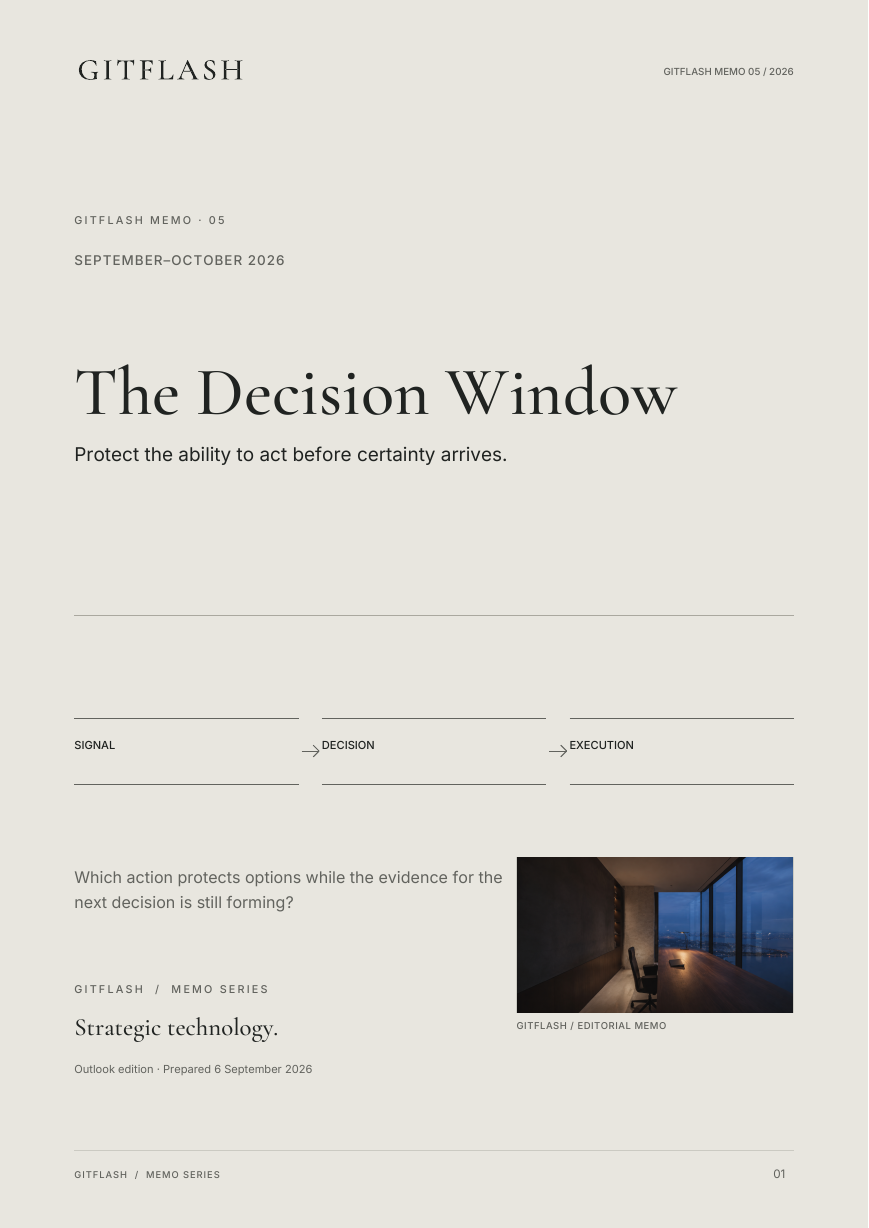
The decision question
Which action protects options while the evidence for the next decision is still forming?
A crisis decision memo that separates urgent protection from attribution and irreversible commitment.
Preview
Evidence that harm is occurring can arrive before evidence of who caused it or what they intend. Faster analysis can help, but it can also make an unverified explanation feel settled.
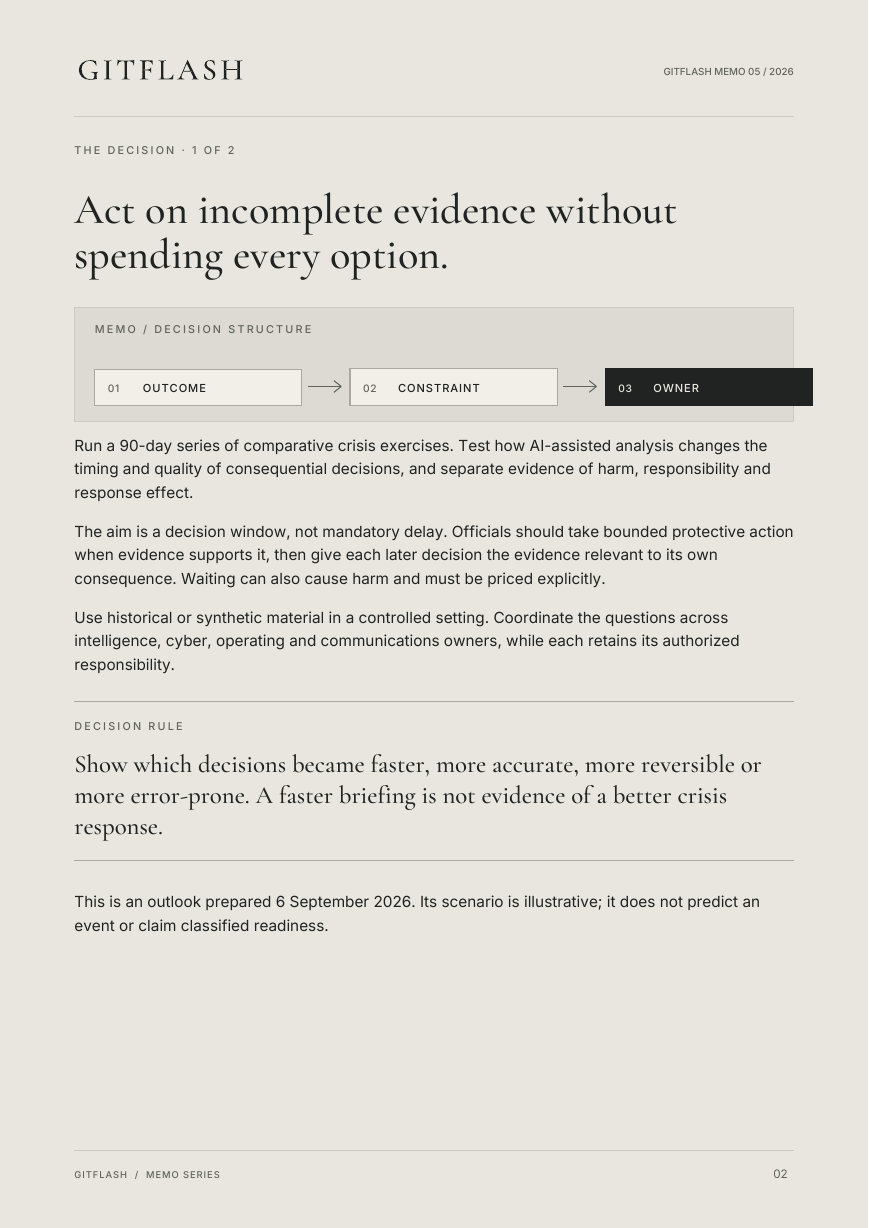
This outlook proposes comparative exercises that test protection, corroboration, communication and correction under pressure.
Contents
- Two windows: protection and commitment
- Why repeated reports are not independent corroboration
- Historical mechanisms and their limits
- Three crisis postures
- A 90-day exercise that changes the workflow
Takeaways
- Match evidence to the action it must justify.
- Preserve options without treating delay as a universal rule.
- Rehearse correction before a crisis makes it expensive.
Sources
- 1. Incident Response Recommendations and Considerations for Cybersecurity Risk Management: A CSF 2.0 Community Profile
National Institute of Standards and Technology · April 2025
SP 800-61 Revision 3. Integrates preparation, detection, response and recovery into cybersecurity risk management; not a doctrine for interstate escalation.
- 2. Contextualizing Deepfake Threats to Organizations
National Security Agency, Federal Bureau of Investigation and Cybersecurity and Infrastructure Security Agency · 12 September 2023
Joint Cybersecurity Information Sheet, September 2023 version. Describes impersonation and synthetic-media risks; not evidence of a specific current incident.
- 3. Intelligence Community Directive 203: Analytic Standards
Office of the Director of National Intelligence · 2 January 2015, as amended; accessed 6 September 2026
Standards for source quality, uncertainty, assumptions, alternative explanations and timely intelligence. These support analytical discipline, not a particular policy choice.
- 4. Summary Record of the Eighth Meeting of the Executive Committee of the National Security Council
U.S. Department of State, Foreign Relations of the United States, Volume XI, Document 94 · 27 October 1962, 16:00
Contemporaneous meeting record in the official historical collection. Illustrates conditional decisions amid uncertainty; it does not isolate the cause of the crisis outcome.
- 5. White House Announcement of Agreement To Link Washington and Moscow by Direct Telecommunications Facilities
The White House; archived by the American Presidency Project, University of California, Santa Barbara · 20 June 1963
Primary presidential announcement of the communications agreement and its stated purpose. It is not evidence of present-day channel readiness.
- 6. National Security Presidential Memorandum/NSPM-11
The White House · 5 June 2026
AI adoption and assurance directive for the national-security enterprise. The proposed exercise is an analytical recommendation, not an announced government program.